



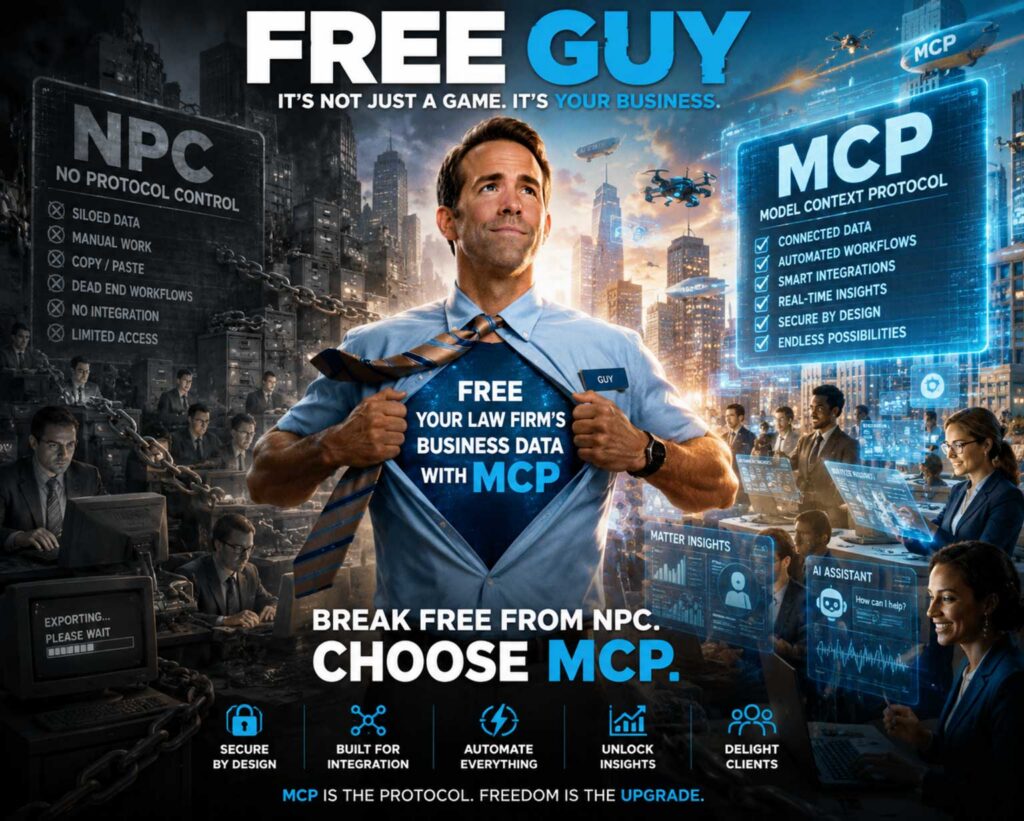
The NPC Problem
In video games, NPCs—non-player characters—exist inside the world but have limited agency:
- They follow scripts
- They repeat the same actions
- They react only when prompted
- They cannot participate in the larger story
In the 2021 movie Free Guy, an NPC named Guy suddenly becomes self-aware and starts actually participating in the game. Your law firm’s business data has the same potential. Maybe not becoming self-aware, but getting into the game!
- Need a billing report?
Run a report - Need collections data?
Export a spreadsheet - Need realization metrics?
Pull another report - Need to answer a management question?
Combine data from multiple systems and manually assemble the answer
The information is technically available, but every interaction follows a predefined script: human beings serve as the translators between systems.AI encounters the same limitations. Without a standardized way to access operational data, every AI initiative becomes a custom integration project.
Every workflow starts from scratch. Every connection increases complexity. Every deployment becomes more expensive than it should be.
Law firm operational data remain as NPCs in an increasingly AI-native world.

AI Is Only As Good As The Data It Can Reach
The firms that will gain the greatest advantage from AI won’t necessarily be those that buy the most AI tools.
They will be the firms that make their operational data accessible.
Imagine asking:
- “Which clients are most likely to pay late this month?”
- “What matters have significant work in progress but haven’t been billed?”
- “Which practice groups are experiencing realization declines?”
- “Show me the collections activities producing the highest recovery rates.”
These are not legal questions. They are business questions.
And they often generate more value than many of the legal tasks currently receiving AI attention.
The challenge isn’t that AI lacks the ability to answer these questions, but that the data required to answer them remains locked inside disconnected systems.

Enter MCP
Model Context Protocol (MCP) is emerging as the standard for connecting AI systems to external data and applications.
Think of MCP as the universal language that allows AI to interact with business systems in a structured, secure, and predictable way.
Instead of building a custom integration for every AI application, firms can expose information once through an MCP server and make it available across an expanding ecosystem of AI tools.
For law firm finance and operations leaders, MCP creates something that has largely been missing from the business side of legal operations: interoperability.
- Financial workflows become accessible
- Collections intelligence becomes actionable
- Billing data becomes conversational
- Operational systems become participants rather than repositories
From NPC to Player Character
The real opportunity isn’t simply connecting AI to law firm data. The opportunity is changing the role that data plays within the organization.
Today, business data is largely reactive:
- Someone asks a question
- Someone exports a report
- Someone interprets the results
- Someone decides what to do next
Now, business data can become proactive:
- AI can identify risks before they become problems
- Collections workflows can prioritize the accounts most likely to pay
- Finance teams can receive prioritized insights instead of reports
Instead of your CFO running a collections report every Monday morning, imagine the AI surfacing at-risk accounts automatically — ranked by likelihood of late payment, with recommended next actions — before anyone asks.
Leadership teams can engage directly with operational insights through natural language.
The data stops waiting for instructions. It starts participating in outcomes.

The Future Belongs to Connected Firms
The legal industry has spent decades digitizing information. The next decade will focus on activating it.
The firms that thrive will not simply possess more data: they will make their data available to the systems, workflows, and AI platforms that create value from it.
The conversation about AI often centers on models, which are rapidly becoming commodities. Every few months a new release outperforms the last, and yesterday’s breakthrough quickly becomes table stakes. The question of which model to use is becoming far less important than what data you can give it to work with:
- Context
- Operational knowledge
- Firm-specific insight
The competitive advantage will belong to firms whose business data is no longer trapped behind exports, reports, and manual workflows.
In other words, firms that stop treating their business data like an NPC. Because in the age of AI, the firms that win will be those whose data can actually join the game.